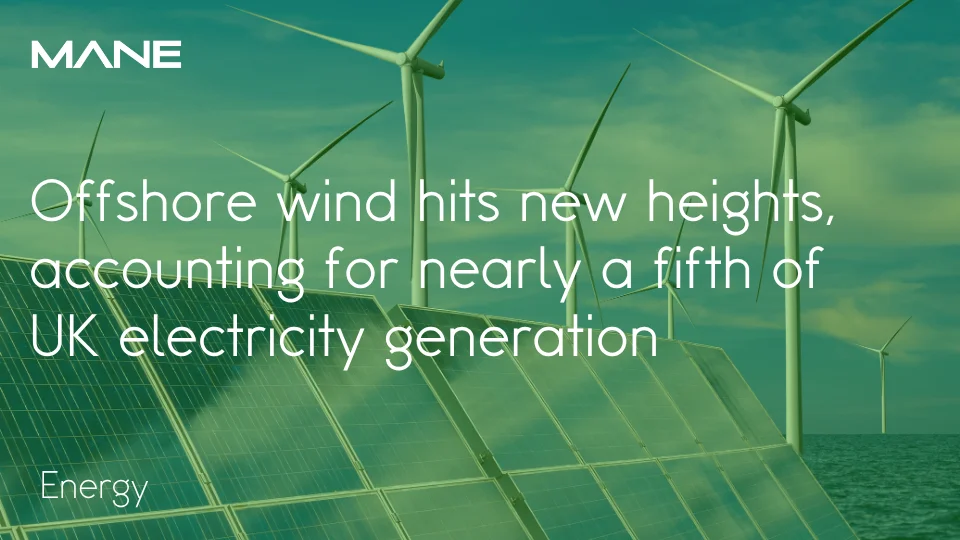
Offshore wind hits new heights, accounting for nearly a fifth of UK electricity generation
16 Jun, 20264 MinOffshore Wind Hits New Heights, Accounting for Nearly a Fifth of UK Electricity GenerationTw...

Offshore Wind Hits New Heights, Accounting for Nearly a Fifth of UK Electricity Generation
Twenty-five years ago, the UK's offshore wind sector consisted of two turbines off the coast of Northumberland. By 2025, it had grown to nearly 3,000 fully commissioned turbines, 16.5GW of grid-connected capacity, and enough annual output to power 15.5 million homes. That is not incremental progress. That is an industrial transformation.
The numbers from The Crown Estate's latest UK Offshore Wind Report make the scale of that shift hard to ignore. Offshore wind generated 52TWh in 2025, accounting for nearly a fifth of the UK's total electricity generation and cementing its position as the country's leading source of renewable energy. Renewable energy as a whole reached 54% of UK electricity generation, up from 52% the previous year, with offshore wind and solar driving the increase.
Julia Rose, Head of Offshore Wind at The Crown Estate, put it plainly: "In just 25 years, offshore wind has grown from an emerging technology into a core part of the UK's energy mix. Today, it is delivering clean energy for households, jobs within communities and contracts for businesses across the country, standing as one of the UK's greatest industrial success stories in modern times."
A Pipeline That Signals Real Confidence, Not Just Ambition
Pipelines in energy are easy to talk up. A number on a slide deck, a map with coloured dots, a headline figure that sounds impressive until you ask how much of it is actually moving. The 93GW pipeline the Crown Estate identifies for UK fixed and floating offshore wind is a different kind of number, because a meaningful portion of it is already in motion.
The most telling signal is the construction uplift. The UK had 7.8GW under construction in the previous reporting period. That figure has now risen to 11.4GW, covering eight wind farms, 801 turbines, and 11 substations. That is not aspiration. That is steel in the water and contracts being executed. When construction activity jumps by nearly half in a single year, it tells you something real about developer confidence and supply chain readiness.
The pipeline has further structural backing beyond what is already being built. Allocation Round 7 secured a record 8.4GW through Contracts for Difference, making it the largest offshore wind auction Europe has ever seen. Those contracts give developers the revenue certainty to commit capital, which is precisely why they translate into activity rather than sitting as planned capacity indefinitely.
Energy Security Is No Longer an Abstract Argument
The numbers here are worth sitting with for a moment. Offshore wind displaced 20.8 million tonnes of CO2 in 2025 alone. That is not a projection or a modelled scenario. It is what the sector actually delivered, in a single year, through capacity that is already built and operating. For anyone who has grown weary of climate commitments that exist mainly on paper, that figure carries real weight.
Julia Rose, Head of Offshore Wind at The Crown Estate, put it plainly: "Recent global volatility has reinforced the critical importance of energy security and a decarbonised system." It is a measured observation, but the context behind it matters. When energy prices spike because of events beyond the UK's control, domestically generated renewable power offers something that imported fuel simply cannot: insulation from that volatility. Not immunity, but a meaningful degree of protection that grows as the sector's share of generation increases.
What makes offshore wind's position genuinely unusual is that it advances three goals that rarely align this neatly. Energy security, economic growth, and climate resilience tend to pull in different directions when you are making policy trade-offs. Here, they are pointing the same way.
The Supply Chain Behind the Turbines
The numbers behind offshore wind tend to focus on megawatts and gigawatts, which is understandable. But the economic story running beneath the turbines is worth pausing on, because it tells you something important about what kind of industry this actually is.
The UK offshore wind supply chain now spans around 2,000 companies and factories, spread across 70 parliamentary constituencies. That geographic breadth is significant. This is not a sector clustered around a handful of industrial hubs or concentrated in one corner of the country. It reaches into communities across England, Scotland, Wales, and Northern Ireland, through manufacturing facilities, logistics operations, engineering services firms, subsea cabling specialists, and port infrastructure providers. The work is varied, the locations are diverse, and the economic contribution is genuinely distributed.
The supply chain is estimated to contribute £18.2 billion to the UK economy over the next ten years, though it is worth noting that no detailed methodology sits behind that figure in the published material. Even setting the precise number aside, the direction of travel is clear. With 11.4GW now under construction and a 93GW pipeline behind it, the demand flowing through that supply chain is only going to grow.
Where the Talent Demand Is Heading and What That Means for Hiring
The numbers tell a clear story. Around 40,000 people currently work in UK offshore wind, and projections suggest that figure could reach 94,000 by 2030. Whether or not that upper estimate proves exact, the direction of travel is not in doubt. The jump from 7.8GW to 11.4GW under construction in a single year is not an abstract statistic. It translates directly into immediate demand for engineers, project managers, commissioning specialists, and technical operations professionals, across multiple sites and at pace.
Floating offshore wind adds another layer of complexity to the talent picture. Skills in this space are still being defined, which creates genuine early-mover opportunities for candidates willing to develop expertise now, and for employers who invest in building that capability rather than waiting for a mature talent pool that does not yet exist.
Geography matters here too. Because the supply chain spans around 2,000 companies across 70 parliamentary constituencies, hiring pressure is not concentrated in the traditional energy hubs. Businesses in coastal manufacturing towns, port communities, and engineering clusters across Scotland, the North East, Yorkshire, and Wales are all feeling the same pull on skilled people.
The Next Chapter Is Already Being Written
Twenty-five years is a useful marker. But if you're trying to understand where offshore wind is heading, the milestone itself is less interesting than what the next decade looks like given everything now in motion. A 93GW pipeline, record auction results from Allocation Round 7, a supply chain spanning 2,000 companies, and construction activity that has jumped from 7.8GW to 11.4GW in a single year. That's not a sector coasting on past success. That's a sector building hard toward something considerably larger.
For professionals weighing up a move into offshore wind, the timing is genuinely strong. Demand for skilled people is rising across engineering, project management, operations, and commercial functions, and the workforce picture over the next five years points toward significant growth. Getting in early, before competition for the best roles intensifies further, is a reasonable strategy.
For businesses scaling their teams, the challenge is real. The talent pool hasn't grown at the same pace as the sector's ambitions, and the organisations that tend to hire well in this market are the ones that engage early and think carefully about what they actually need. If you're building a team or looking for your next move in offshore wind, get in touch.
Related Posts
When the Thermometer Becomes an Energy Problem
18 Aug, 2026
When the Grid Strains, the Talent War Heats Up
25 Jun, 2026