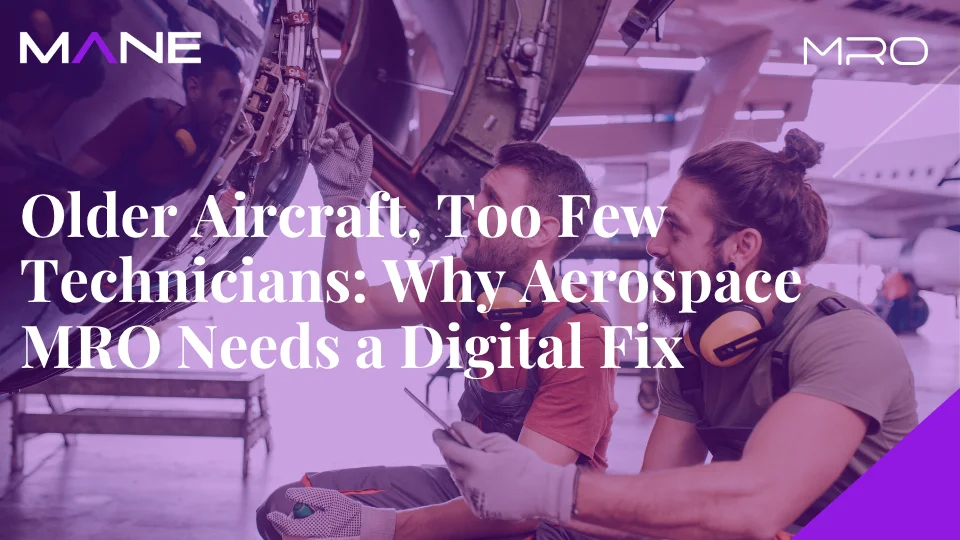
Older Aircraft, Too Few Technicians: Why Aerospace MRO Needs a Digital Fix
10 Jun, 20263 MinThe Squeeze Is Real, and It Is Getting WorseThe numbers are stark, and the direction of trav...

The Squeeze Is Real, and It Is Getting Worse
The numbers are stark, and the direction of travel is clear. Manufacturers cannot build new aircraft fast enough to meet demand, which means airlines are flying older airframes for longer, and those airframes need more attention, more often, and with greater technical complexity. At the same time, the pool of qualified people available to do that work is shrinking.
Boeing projects that demand for maintenance hours will grow from 310 million a year to 565 million by 2043. That is not a modest uptick. It is a near-doubling of workload in under two decades, against a workforce that is already stretched.
MRO providers are caught between two forces they cannot control. On one side, the maintenance burden keeps rising. On the other, the industry needs more than 600,000 qualified maintenance professionals by 2037, yet training pipelines are producing fewer graduates than the sector loses to retirement and attrition each year. Hiring more people sounds like the obvious answer. It is not a realistic one on its own. Training and certifying a new technician takes two to three years, and that is before they develop genuine proficiency across multiple aircraft systems. You cannot accelerate that timeline by wanting it to be shorter.
Charging more is equally constrained. Airlines operate on margins that leave little room for absorbing cost increases, and the competitive pressure on MRO pricing is not easing. The squeeze is real, and it is getting worse.
Why the Technician Shortage Is Not Going Away
The numbers here are not ambiguous. The Aviation Technician Education Council projects a 20% shortfall in certified maintenance technicians by 2028, and the pipeline producing those technicians is not going to close that gap any time soon. Training and certifying a new technician takes two to three years at minimum, and that gets you to baseline competence, not the kind of cross-system proficiency that complex MRO work actually demands. You are looking at considerably longer before someone is genuinely productive across multiple aircraft systems.
Meanwhile, the industry is losing experienced people faster than it can replace them. Retirement attrition is steady and predictable, and the graduates coming through simply do not outnumber those walking out the door. That is the structural reality, and it is why, as one industry assessment puts it plainly: "The technician shortage is not cyclical, it is permanent."
The downstream effects are already visible and measurable. Engine repair wait times have increased by 150% for modern engines. Heavy check turnaround times are now running 45 days longer than pre-pandemic baselines. In the military, government reports indicate that roughly 20% of fighter aircraft are grounded at any given time, waiting on parts. That last figure is worth sitting with for a moment, because it illustrates that this is not a commercial aviation problem in isolation. The constraint runs across both sectors.
Half the Day Is Not Spent on the Aircraft
Roughly half of a technician's working day is not spent on the aircraft. That figure, drawn from analysis of how maintenance time is actually distributed, points to something that should focus every MRO leader's attention: the capacity problem is not only about headcount. A significant portion of it is already sitting inside your existing workforce, locked up in waiting, searching, and chasing.
The activities eating that time are familiar to anyone who has spent time on a hangar floor. Technicians waiting for parts that were not staged before the job started. Time spent hunting through paper records or navigating disconnected digital systems to find the right documentation. Authorisation questions that should have been resolved before the aircraft arrived, but weren't. None of this is wrench time. None of it moves the aircraft closer to return to service.
As one analysis put it plainly: "Every additional minute of wrench time for a technician increases throughput and gets assets back in service." The logic is straightforward, but the operational implications are significant. If you can recover even a portion of that lost time through better preparation, the capacity gain is real and it does not require a single additional hire.
Digital planning and work preparation tools address this directly. Before an aircraft arrives, they ensure parts are staged, documentation is accessible, tooling is confirmed, and authorisation paths are already cleared. The maintenance event starts ready, not behind.
Supply Chain Visibility Is the Missing Piece
Parts availability has quietly become one of the most stubborn constraints in MRO operations, and it does not get the attention it deserves. The conversation tends to focus on technician numbers, which is understandable, but a fully staffed hangar still loses days when the right component is not where it needs to be.
The problem is structural. Rotable components, engines, auxiliary power units, gearboxes, avionics, cycle through complex ownership and custody chains involving lessors, operators, OEMs, and third-party MROs. At each handoff, visibility tends to drop. Nobody has a clean, real-time picture of where a given component is, what condition it is in, or when it will actually be available. OEMs are making production and stocking decisions without reliable demand signals, which means parts sit waiting for an aircraft, or an aircraft sits waiting for parts. Either way, the turnaround clock is running.
The knock-on effects compound quickly. Some airlines have started stockpiling components to protect themselves against unpredictable supply, which sounds pragmatic until you consider that it increases inventory pressure across the entire system and distorts the demand signals that everyone else is trying to act on. Better supply chain visibility, shared across the network in something closer to real time, is what breaks that cycle.
What This Means for Hiring, Talent Strategy, and MRO Jobs
Digital transformation does not exist in isolation from the people doing the work. The two have to develop together, and that has direct implications for how MRO providers think about hiring, skills development, and the long-term talent pipeline.
The good news is that digital tools are genuinely expanding what is possible on the hiring side. AR and VR training platforms are one of the more practical examples. Rather than waiting years for a technician to accumulate hands-on experience across multiple aircraft systems, these tools compress that learning curve in a meaningful way. That matters when training and certification already take two to three years before a technician is fully productive, and longer still to reach genuine proficiency across complex platforms. Anything that accelerates that journey without compromising standards is worth taking seriously, and it also makes the role more accessible to candidates who might previously have been ruled out on experience grounds alone.
Knowledge management systems address a different but equally pressing problem. Every time a senior technician retires, a significant body of institutional knowledge walks out with them. Capturing that expertise in structured digital form, before it disappears, gives the next generation something to work with. It is not a perfect substitute for experience, but it is considerably better than starting from scratch, and it shortens the time it takes for newer hires to reach genuine usefulness.
There is also a broader point worth making here. Organisations that invest in digital infrastructure tend to attract better candidates. Technicians, particularly younger ones entering the workforce, want to work in environments where the tools match the complexity of the job. A well-run, digitally enabled MRO operation is a more compelling place to build a career than one still running on paper-based processes and disconnected systems. That is not a soft benefit. It is a competitive advantage in a market where qualified candidates have options.
For independent MROs, the calculus here is particularly sharp. Without the scale to absorb a dedicated transformation team, every investment decision carries more weight. Targeted digital tools that reduce administrative burden, clarify processes in real time, and help existing technicians work more effectively are the ones that deliver a return quickly, and they also make the organisation a more attractive employer in a tight market.
The Window for Early Movers Is Open, but Not Indefinitely
Most MRO organisations are not yet facing a competitive crisis from digital laggards. The honest picture is that the majority are still in pilot mode, running proof-of-concept projects or early-stage deployments rather than operating at scale. That means the gap between early movers and late adopters has not fully opened yet. But it is opening, and the organisations building data capabilities and digital workflows now will find it increasingly difficult to be caught.
The challenges standing in the way are genuine. Limited IT resource, legacy processes that have been embedded for decades, and the very real difficulty of transforming operations without pausing the revenue-generating work that keeps the business running. Independent MROs feel this most acutely, without the scale to absorb a dedicated transformation team or the headroom to absorb short-term disruption.
What separates organisations that navigate this well from those that lurch from one capacity crisis to the next is not ambition. It is sequencing. Knowing which digital investments deliver the highest near-term impact, and building from there, is what turns a transformation programme into something that compounds rather than stalls.
MRO providers cannot solve the technician shortage through hiring alone, and they cannot solve it through digital investment alone. The organisations that will come out ahead are the ones treating both as part of the same strategy, building the tools that make their people more effective while simultaneously investing in the talent pipeline that keeps the workforce moving forward.
If you are thinking about how your organisation is positioned on either side of that equation, we would be glad to talk it through.
Related Posts

Middle East MRO Is Becoming a Geopolitical Function
08 Jun, 2026