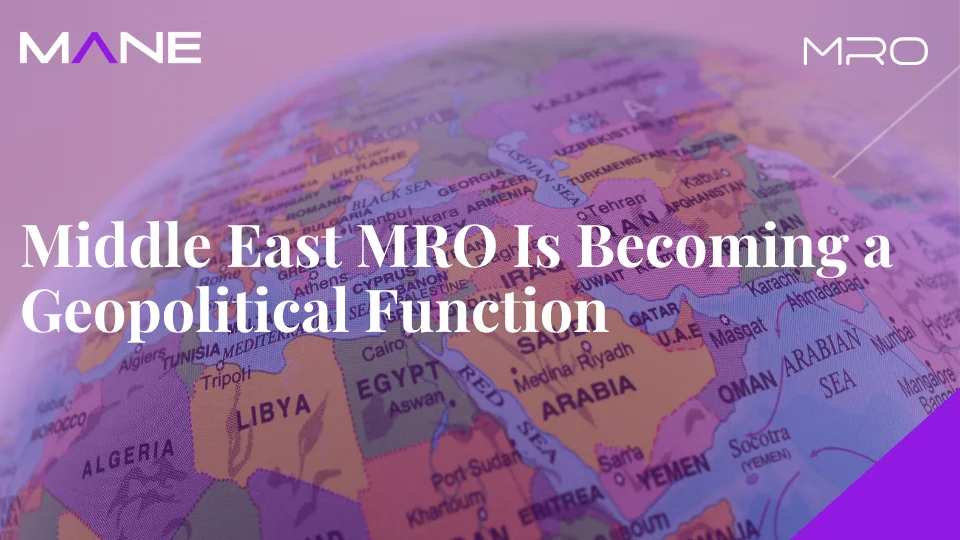
Middle East MRO Is Becoming a Geopolitical Function
08 Jun, 20264 MINThe Gulf MRO Model Was Built on a Bet That Stability Would LastThe Gulf aviation boom was bu...

The Gulf MRO Model Was Built on a Bet That Stability Would Last
The Gulf aviation boom was built on a clear and deliberate bet. Stable hubs, predictable transit routes, consistent regional access: these were not just operational conveniences, they were the structural logic on which an entire industry was constructed. MRO services grew as a natural extension of that hub model, optimised for scale and efficiency rather than resilience. The assumption was that the conditions enabling the model would hold. For a long time, they did.
The Iran War is now testing that assumption directly. Not in the way that a supply chain disruption or a temporary airspace restriction might, where you absorb the friction, adapt, and return to normal. This is something more fundamental. The conflict is placing pressure on the underlying logic of Gulf MRO, the idea that you can build a maintenance ecosystem around predictability and then run it at maximum efficiency because the environment around it will remain stable.
What happens to MRO when that stability is no longer guaranteed? That is the question the industry is now being forced to answer, whether it is ready to or not. The core operational question is shifting from how to service aircraft more quickly and cost-effectively, to how to maintain aircraft when they are no longer in use.
When Aircraft Stop Going Where They Are Supposed To
Rerouting is not a new concept in aviation. But what's happening across Gulf airspace right now is different in character from the kind of occasional diversions the system was built to absorb. Partial airspace closures, shifting transit corridors, and the unpredictability of where an aircraft will actually end up at the end of a flying day are becoming routine features of operations rather than exceptions to them.
That matters enormously for MRO planning, because hub-centric maintenance models are built on predictability. The assumption is that aircraft return to base, that overnight patterns hold, and that scheduled maintenance can be planned around known locations and known intervals. When those assumptions start to erode, the whole planning architecture becomes harder to rely on.
What operators are dealing with now is a system absorbing disruptions it was never designed to handle on a sustained basis. Crews are displaced. Assets are not where the schedule said they would be. Maintenance is happening outside planned locations, sometimes at stations with limited tooling, limited parts access, and limited qualified personnel. The system copes, but coping is not the same as functioning well.
The operational question at the centre of all this has shifted. It used to be about speed and cost: how do you turn aircraft around efficiently, keep inventory lean, and drive down unit costs across a high-volume hub? That logic still exists, but it is no longer the dominant one.
The Wear and Tear Problem Nobody Is Talking About Yet
There is a quieter problem sitting underneath the rerouting headlines, and it is one that the industry has not fully started to reckon with yet.
When aircraft are pushed onto longer routes, diverted more frequently, and asked to lean harder on auxiliary systems, the operational profile of the fleet changes. Not dramatically, not all at once, but consistently. Hours accumulate in ways that were not planned for. Cycles run differently. The assumptions baked into maintenance schedules, which were built around predictable hub operations and stable turnaround patterns, start to drift away from reality.
Engines are the obvious pressure point. More hours in less-than-ideal conditions, combined with the thermal stress of operating in high-temperature environments with irregular turnarounds, will bring some engines to their maintenance thresholds earlier than forecast. Brake and tyre wear follows a similar logic. Unpredictable operations mean unpredictable landing loads, and that adds up. Environmental control systems, already working hard in Gulf conditions, face compounded stress when ground time becomes irregular and cooling cycles are disrupted.
None of this is a crisis today. That is precisely what makes it easy to underestimate.
Wear profile shifts are slow-burn pressures. They do not trigger alerts or make headlines.
If the Conflict Runs Long, the Geography of Heavy Maintenance Will Shift
Line maintenance will stay where the aircraft are. That part of the equation is not going anywhere, because you cannot separate routine servicing from the operational hub it supports. But heavier maintenance is a different matter entirely, and if the current geopolitical environment persists beyond a year, the geography of where that work happens is likely to shift in ways the industry has not had to seriously consider before.
The logic is straightforward, even if the implications are not. In a stable world, heavy maintenance follows cost and capability. In a volatile one, it will follow access, insurability and predictability. That is not a prediction so much as a description of how procurement decisions actually get made when risk profiles change. Airlines and lessors do not move major check work lightly, but they do move it when the alternative is uncertainty about whether a facility will be accessible, insurable, or operationally viable six months from now.
A prolonged conflict introduces exactly that kind of uncertainty. What you start to see is fragmentation. The Gulf MRO system, which was built as a coherent, integrated network around hub efficiency, begins to pull apart at the seams. Lighter work stays local. Heavier work gravitates toward regions that offer continuity, even if those regions are more expensive or less conveniently located.
This is not a collapse. It is a reordering.
What This Means for Hiring, Talent Strategy, and MRO Workforce Planning
A structural shift in MRO geography does not stay contained to operations for long. It moves into workforce planning, often faster than businesses expect.
When maintenance activity becomes less predictable in location and timing, the demand for flexible, deployable technical talent increases. Engineers and technicians who can work effectively outside familiar hub environments, adapting quickly to different facilities, tooling setups, and regulatory contexts, become genuinely valuable rather than just convenient. That is a different profile from the one most Gulf MRO hiring has been built around.
Roles focused on parts availability, logistics coordination, and rapid-response line maintenance are already growing in strategic importance. These are not glamorous functions, but in a resilience-driven model they sit close to the operational core. If an aircraft is diverted and needs attention somewhere outside the planned network, the people who can mobilise quickly and source components under pressure are the ones keeping the operation moving.
The deeper point is this: you cannot build a resilience model without the people to run it. Talent strategy and operational strategy are not separate conversations at this point. Providers who are rethinking their geographic footprint need to be rethinking their hiring in parallel, not six months later.
That is where regional knowledge genuinely matters. Middle East MRO recruitment is different to recruitment in other parts of the world. Middle East MRO jobs are recruited for in a slightly different way.
Not the End of Middle East MRO. The Beginning of a Different Version of It.
None of this should be read as a counsel of despair. The disruption is real, but so is the opportunity for those who read it clearly.
'What may emerge from the Iran War is not the decline of Middle East MRO, but its transformation: from a system optimised for hub efficiency into one increasingly organised around geopolitical resilience.' That reframing matters. Providers who treat the current environment as a temporary inconvenience to be waited out will find themselves poorly positioned when the dust settles. Those who adapt their operations, their networks, and their workforce to a resilience-first logic will find genuine competitive ground to stand on.
The shift from efficiency to resilience is not a retreat. It is a structural evolution, and structural evolutions create new roles, new priorities, and new demands on the people filling them. 'The key question is no longer where maintenance is cheapest, but where it remains possible.' That single change in question reorders almost everything, including who you need, where you need them, and what they need to be able to do.
For businesses navigating this, the strategic and workforce questions are converging faster than most hiring plans anticipated. Getting the right balance, and the right Middle East MRO recruiter to assist is vital.