Austin 2026: Antonelli's Ninth Win Leaves Him One Point Away From History
26 Oct, 20264 MinThe title was not confirmed in Texas. Hamilton finished fourth, Russell eighth, and the prec...

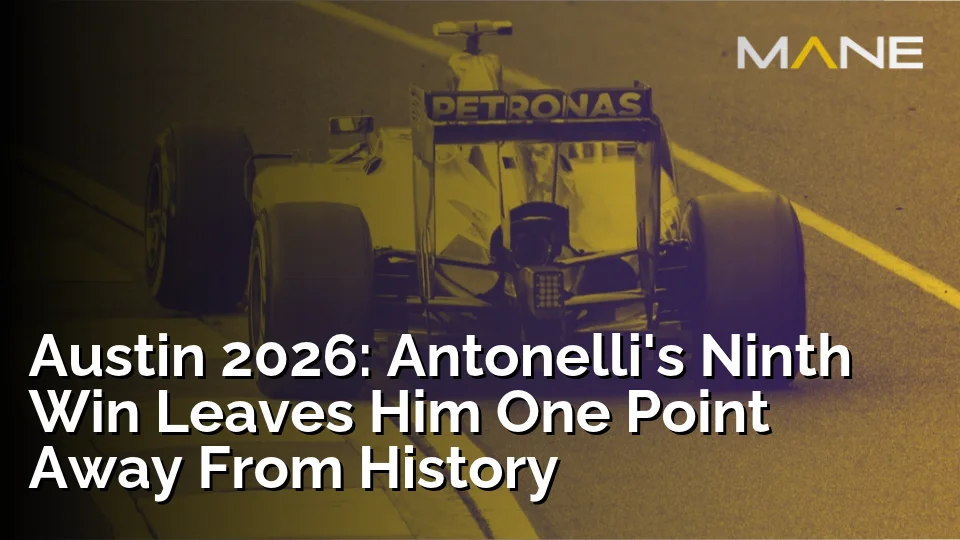
The title was not confirmed in Texas. Hamilton finished fourth, Russell eighth, and the precise mathematical requirement for Antonelli to clinch it in Austin went unmet by the narrowest of margins. But those facts tell only a fraction of the story. What actually happened at the Circuit of the Americas on Sunday was a comprehensive demonstration of why Kimi Antonelli is about to become the youngest world champion in Formula 1 history.
He won by 13 seconds on a one-stop strategy while his closest rivals burned through two sets of tyres. He qualified on pole in what Toto Wolff described as a miracle lap, the first pole in eight races. He has won nine times this season. He leads the championship by 123 points over Russell and 124 over Hamilton with a maximum of 125 available across the remaining four rounds. He needs a ninth-place finish in Mexico City next weekend to be mathematically certain of the title. In practice, he is already champion. The paperwork simply has not arrived yet.
How Antonelli Won the Race
The strategic story of Austin was built on a single decision made by Mercedes before the pit stop phase had even begun. Antonelli started on the medium tyre while Verstappen, Leclerc, Hamilton and the Red Bulls behind him all opted for the faster but less durable soft compound. The conventional wisdom at COTA, given the tyre degradation levels seen in practice, pointed toward a two-stop race. Mercedes looked at the data and decided the conventional wisdom was wrong.
The first sign that they might be right came immediately. Despite being on a tyre with less grip than most of those behind him, Antonelli's getaway at the lights was exceptional, and he had the lead into turn one before anyone could threaten. Verstappen, who had been targeting a third consecutive win, lost second place briefly to Leclerc through the esses before recovering it by turn thirteen. By then Antonelli had already established breathing room at the front.
Red Bull pitted Verstappen surprisingly early on lap 13, locking him into a two-stop race. Ferrari followed with their drivers. Mercedes kept Antonelli out, watching his lead over the field grow as those around him cycled through their fresh soft tyres. When they finally pitted him at the end of lap 24, switching to the hard compound, he rejoined fourth. By lap 32 he had passed Leclerc to retake the lead, and from that point the race was functionally over.
The closing laps produced genuine excitement around the podium positions as Leclerc and Verstappen traded places late on and Hamilton charged hard at the Red Bull from behind, but none of it threatened Antonelli at the front. He crossed the line 13 seconds clear of Leclerc, who had driven well to take second. The winning margin was a statement. This was not a race won on circumstances or safety car fortune. This was a driver and a team who identified the correct strategy on a complex tyre day and executed it with precision.
"Perfect execution from strategy to call the one-stop," Antonelli said afterwards. "Really happy we made it stick. Today was a great team effort." Wolff called it exceptional. Both assessments were accurate.
Red Bull's Frustrating Day
Verstappen and Hadjar had been among the most impressive qualifiers at COTA, the Red Bull showing genuine pace on Saturday that made a third consecutive win appear realistic. Sunday was considerably more complicated.
The clutch at the start did not deliver the deployment Hadjar was expecting, and he dropped from third to fifth in the opening exchanges, never fully recovering the position. More damagingly, both Red Bull drivers spent significant portions of the race fighting their own car rather than their rivals. Verstappen described it as undriveable at various points, had no clarity on the state of his front wing when asked directly, and ran into a poor second stint on the soft compound. He required a second stop that compromised his race and left him third rather than fighting for the win.
Hadjar's day was arguably worse. He ended up on incorrect engine mapping after his pit stop, losing around a second per lap on the hard tyre, and was visibly furious about it in his radio messages. He described Red Bull's clutch as fragile and said it needed a redesign. That is not the kind of language a driver uses when they feel the team has things under control. The relationship between Hadjar and Red Bull has shown strain at multiple points this season, and Austin added another difficult chapter.
Red Bull took 23 constructor points from the weekend to Mercedes' 29 and Ferrari's 30. In the context of a constructors' battle where the gaps are real and the remaining rounds limited, that deficit matters.
Leclerc's Strong Second
Charles Leclerc drove a composed and ultimately impressive race to second place, recovering from a difficult first stint on the soft tyre to produce serious speed once he switched compounds. His overtake on Norris and then Verstappen in the closing laps, taking second place with seven laps remaining, was the highlight of his afternoon and demonstrated the form that has made him Ferrari's more consistent points scorer in the second half of the season.
Ferrari took more constructor points than either Mercedes or Red Bull on Sunday, which is not a position they have regularly occupied during this campaign. The new upgrade package brought to Austin appears to have functioned as intended, in contrast to Mercedes' update which struggled at Sepang and Singapore before finally showing its potential here. Ferrari head to Mexico knowing they have the pace to fight for wins and the driver in Leclerc who is capable of delivering them.
Hamilton was fourth, one second behind Verstappen at the flag after closing rapidly in the final laps. He spent much of the weekend chasing a set-up that worked, making front wing adjustments during the race to address understeer, and his race was solid without matching Leclerc's. He is now three points behind his team-mate in the drivers' standings. With his own title fight over mathematically in all but the most extraordinary circumstances, the remaining rounds are about finishing the season with dignity and helping Ferrari's constructors' push. On the evidence of Austin, he is capable of both.
Russell and Another Miserable Sunday
The numbers tell most of the story. Russell started sixth. He finished eighth. In between, he collected a five-second penalty for leaving the track and gaining an advantage during a first-lap battle with Piastri, served it at his pit stop, and emerged behind the McLarens where he remained for most of the afternoon.
He said he had six good laps and fifty bad ones. He described his race pace as rubbish. He said the penalty was the least of his worries, which is a telling admission about the underlying performance. What is particularly difficult to understand is why Austin was so poor when Baku, only a handful of races ago, had been his best weekend of the season. The form has not held. The understanding he felt he had found of the car appears to have been circuit-specific rather than a genuine breakthrough.
Wolff and Mercedes have a genuine engineering problem to solve in the time remaining. The upgrade brought to Malaysia, which is now on Antonelli's car and appeared to work in Austin, was initially not working for Russell in Singapore, where the two cars ran different specifications to gather information. Whether Russell can extract the same performance from the new package as his team-mate in Mexico remains to be seen.
The championship for Russell is over. 123 points with 125 available and four rounds remaining requires Antonelli to fail in ways he has shown no tendency toward. Russell knows this. His focus now is on winning races, which is both the right attitude and a genuine possibility on the right circuit with the right weekend.
Norris and the McLaren Reality Check
Norris turned a poor qualifying into a fifth-place finish that, given the circumstances, was genuinely impressive. McLaren instructed Piastri to let him past early in the race, a decision that reflected how much more Norris has been extracting from a car that both drivers have described as sitting on a performance knife edge, requiring an extremely specific setup window to function properly.
Norris was briefly second during the strategic shuffle and appeared to be in contention for a podium before his tyres deteriorated in the closing laps. Verstappen passed him on lap 47 and Leclerc followed shortly after, leaving him fifth. He was candid afterwards about McLaren's current position in the pecking order, calling them the fourth fastest team and saying the car requires him to drive beyond what is sensible to be competitive with those ahead. Upgrades are coming, starting with a package in Austin that he hoped would close the gap. The evidence of Sunday suggests there is still meaningful ground to recover.
Piastri finished seventh, around 22 seconds behind his team-mate at the flag. The gap between them on the day was significant enough that McLaren's decision to implement team orders was immediately justified by the lap times that followed. It is not the first time this season that Piastri has been the slower of the two McLarens by a margin that defies straightforward explanation.
Lawson was ninth for Racing Bulls, his third consecutive points finish, continuing the development of a driver who looks increasingly settled in a team leader role. Gasly was tenth for Alpine, picking up a point after the contact from Bearman in the early laps that could have ended his race and would have been more damaging without the penalty the stewards applied to the Haas driver.
The Title Picture Heading to Mexico
Antonelli needs ninth place next weekend. That is the clinical summary. In the context of a driver who has won nine of eighteen races this season, ninth place in Mexico City feels less like a target and more like a formality.
The more interesting question is whether he wins the title fighting for the race win or managing his position from the back of the grid. The answer to that will tell us something about what kind of champion he intends to be. On the evidence of Austin, where he could have taken a conservative approach given what was at stake and instead produced his most complete strategic performance of the season, the answer seems clear. He will go to Mexico wanting to win.
He turns 21 in August. He is about to break Sebastian Vettel's record as the youngest Formula 1 world champion. He has done it with nine race victories, a lead that never fundamentally threatened to evaporate despite mechanical failures at Mercedes, multiple incidents beyond his control, and a title rival in Russell who, on his best days, was genuinely pushing him. The sport has not seen a debut championship campaign quite like this.
Mexico City next. The coronation, in all likelihood, awaits.