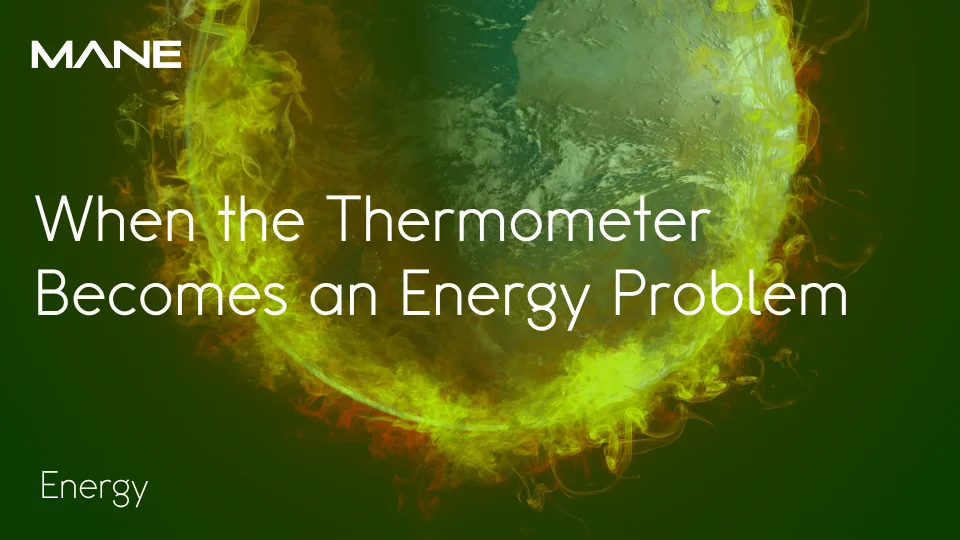
When the Thermometer Becomes an Energy Problem
18 Aug, 20264 MinWhat Europe's hottest summer yet means for the energy workforceEurope has spent much of 2026...

What Europe's hottest summer yet means for the energy workforce
Europe has spent much of 2026 living through one heatwave after another. By mid-August, the continent was already into its fifth of the year, with parts of France and the southeast pushing close to 40°C and the UK forecast to hit 36°C. What's different this time isn't just the number on the thermometer. It's how directly the heat is now hitting the systems that keep the lights on, and the people who build and run them.
The cost is showing up on the balance sheet
Triodos Bank has put a figure on it, and it's a big one: this summer's heat could cost the European economy €180 billion, roughly 1 percent of GDP. That's close to the entire growth the EU was expected to post in 2026, wiped out by weather. France could lose 1.4 percentage points of growth, enough to tip it into contraction, and the Netherlands could see most of its expected expansion swallowed by an 0.8-point hit.
What's striking is that the biggest driver isn't crop failure or wildfire damage. It's people struggling to work in the heat, which on its own could shave around 0.6 percent off EU GDP. Agricultural output is down 3 to 7 percent on top of that, and economists at ING reckon low water on the Rhine, a key route for moving industrial goods, could cost Germany 0.3 points of growth this year by itself.
That cost traces straight back to energy infrastructure
Heat doesn't just push up demand for cooling, it undermines the systems meant to supply it. Romania had to disconnect its only operational nuclear reactor from the grid in August because the Danube ran too low to cool it, and declared a state of energy emergency for the whole month. France and Hungary have both curtailed nuclear output for the same reason, and boats on the Rhine and Danube are sailing half loaded because the rivers are simply too shallow, which is a real problem when those cargoes include raw materials chemical producers rely on.
At the same time, demand keeps climbing. More heat means more air conditioning, which means more gas burned right when storage should be building for winter. EU gas storage was only 59 percent full in mid-August, below where it usually sits this time of year and about where it stood in the tense summer of 2021. Add in a tighter global LNG market, since the Strait of Hormuz has been largely shut to shipping, and European gas prices have been trading near their highest levels since the war in the Middle East began, close to double what they were a year ago.
And it reaches the people keeping it running
This isn't just a numbers problem. It's a health and safety one, with real implications for anyone staffing sites and projects. Heat is Europe's deadliest weather hazard by a wide margin, responsible for around 95 percent of fatalities linked to weather and climate extremes on the continent, and a rapid modeling study of this year's late June heatwave put excess deaths across Europe at over 20,000 for that single event.
For crews out on offshore platforms, substations, cable routes and construction sites, that risk isn't abstract, it's the working day. Germany's own workplace guidance already sets clear thresholds, requiring employers to act once indoor spaces pass 30°C, with anything above 35°C generally unfit for work without special measures. As summers like this one stop being the exception, heat management is becoming a normal part of project planning and workforce scheduling rather than something dealt with case by case.
Which is where the recruitment picture starts to shift
Put those threads together and you can see a pipeline of work taking shape. Romania, France and Hungary all curtailing nuclear output for water and cooling reasons points to a wave of retrofit, redundancy and cooling infrastructure projects ahead, which means more demand for commissioning engineers, asset managers and O&M specialists who understand thermal and water constraints, not just electrical ones.
The same pressure is strengthening the case for renewables and storage. With gas storage running low and prices elevated, utilities have another reason to push ahead with onshore and offshore wind, solar and battery energy storage builds, and every one of those projects needs FEED, installation, commissioning and asset management talent across the specialisms Mane already works in. Water scarcity, which hit 28 percent of EU territory during at least one season in 2023, is pulling power-to-X and utilities work closer together too. Projects sitting at that water-energy nexus, from hydrogen production to cooling system retrofits, need engineers who can work across both disciplines.
And underneath all of it sits the adaptation spending the European Commission says is needed: around €70 billion a year through 2050. For utilities, that turns into new EPC, construction and asset management roles tied to grid hardening and cooling upgrades, layered on top of the renewables buildout already underway.
None of this looks likely to ease up next summer. Triodos Bank's own warning is worth remembering: treating this as a freak event misses the point, because every year of adaptation without emissions reduction is a year borrowed against a hotter baseline. For the energy sector, and for the recruiters and workforce partners supporting it, planning for heat isn't a seasonal task anymore. It's becoming part of the core project pipeline, and the people needed to deliver it.
Related Posts
When the Grid Strains, the Talent War Heats Up
25 Jun, 2026