Monza 2026: Antonelli Writes Himself Into Italian History
07 Sept, 20264 MinSixty Years of WaitingSixty years. That is how long Italy waited for one of its own to win t...

Sixty Years of Waiting
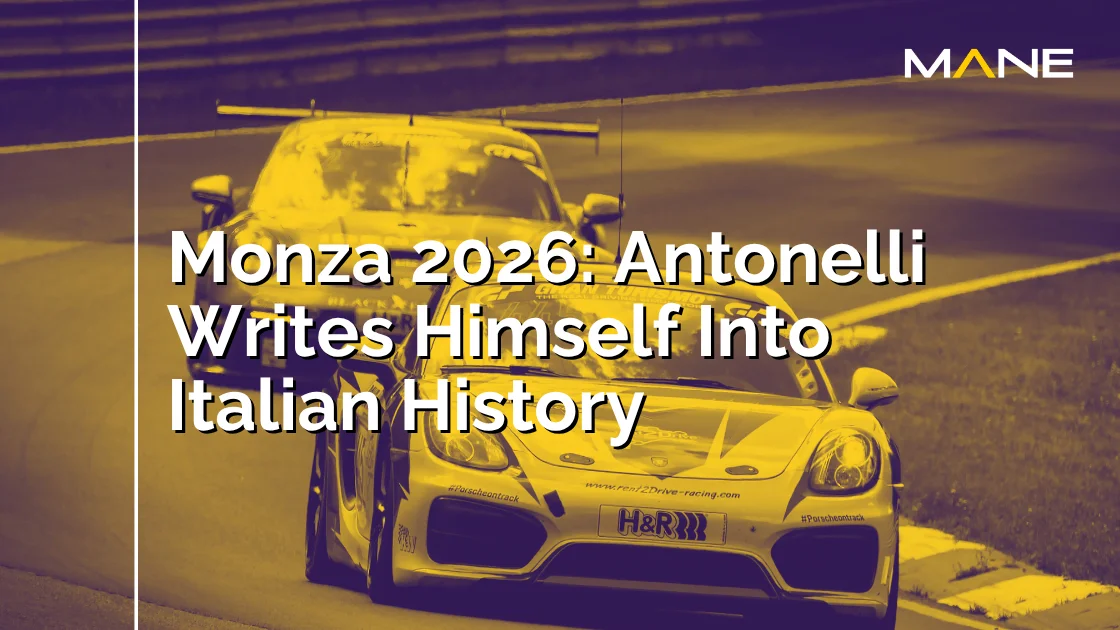
Sixty years. That is how long Italy waited for one of its own to win the Italian Grand Prix, ever since Ludovico Scarfiotti did it in 1966. On Sunday, Andrea Kimi Antonelli ended the wait, and he did it in a way nobody at the track could have scripted: starting nineteenth on the grid, carrying an engine penalty into his home race, and finishing the afternoon as the winner.
Antonelli had said before the weekend that he planned to go "full attack" regardless of where he started. Toto Wolff later admitted he had sensed something coming even before lights out, saying he genuinely believed one of his two drivers was going to win the race, whichever one it turned out to be. It sounded like the kind of thing a team boss says after the fact to look prescient. This time it was true.
The race did not wait long to turn chaotic. Lewis Hamilton went for a move on teammate Charles Leclerc into the first chicane, the two Ferraris ran side by side, and Leclerc pushed him wide on the exit, dropping Hamilton down the order. A lap later, Leclerc's own race ended far more violently. Fighting Oscar Piastri into Parabolica, he ran wide onto the white line, lost the rear of the car, and slammed into the barriers at high speed. He was able to climb out under his own power, but for the tifosi it meant one home hero was already out of the race, and their other one was mired in traffic.
The restart reshaped everything.
Pierre Gasly, who had claimed a stunning maiden pole, held the lead briefly before Russell moved past him and took control. Max Verstappen worked his way into the mix and even led for a spell, a reminder that Red Bull's pace at Monza was never far behind the two Mercedes despite Verstappen complaining his car felt "completely broken" on the rear axle.
Antonelli, meanwhile, was doing exactly what he had promised. Twelfth after the red flag, he picked off cars in bursts, and by lap 13 he was already within two seconds of the lead, trading places with Russell and Verstappen in a rapid-fire sequence of overtakes driven by Monza's slipstream and the battery deployment quirks of the 2026 cars. He took the lead outright on lap 18, prompting his own engineers to ask both Mercedes drivers to stop trading places and build a gap over Verstappen instead. Antonelli's reply over the radio was blunt: if he backed off, Russell would simply pass him again.
A Strategic Turning Point
The turning point arrived on lap 28, when Lance Stroll's Aston Martin broke down with a hydraulic issue and triggered a virtual safety car. Antonelli, running on ageing mediums fitted at the red flag, pitted for a fresh set. Verstappen did the same. Russell, on hard tyres that Mercedes believed could go the distance, stayed out. It was, as strategist Andrew Shovlin admitted afterwards, a deliberate split of strategies precisely because nobody was sure which tyre would win the day.
Antonelli’s Charge to Victory
It very nearly didn't matter how the tyres compared, because Antonelli made his own pace count. He sliced back through the field, past Hamilton and Piastri, and closed relentlessly on his teammate as Russell's hard tyres began to show their age. By lap 47 the gap was under a second. Antonelli's first attempt, at the first chicane on lap 49, went wrong: he ran wide, dropped his wheels into the gravel, and had to settle for staying close rather than making the pass. He recovered by the following lap and completed the move cleanly between the second Lesmo and the Ascari chicane, taking a lead he would not relinquish.
Russell was left to reflect on a race he might well have won without the VSC's timing, and he said as much afterwards, while still crediting Antonelli's pace as simply too strong to hold off. Verstappen completed the podium in third, a result built on aggressive overtaking rather than outright speed. Norris beat Piastri to fourth in a tight, wheel-banging fight for McLaren, while Hamilton trailed home sixth, well adrift of the podium fight after his early clash with Leclerc. Gasly, who had led from a sensational pole, faded to seventh, still enough to top the midfield for Alpine.
It was a miserable day further down the order for the home team in another sense. Both Aston Martins retired, Alonso with suspected damage from running wide and Stroll with the hydraulic failure that had shaped the whole race. Carlos Sainz brought his Williams home thirteenth, and Franco Colapinto, who had briefly looked capable of a podium challenge for Alpine after climbing to fourth at the restart, ran wide fighting Verstappen and dropped away, finishing ninth after clawing back what he could.
Antonelli Strengthens His Championship Lead
For the championship, the numbers tell their own story. Antonelli now leads Russell by 66 points, with Hamilton a further stretch back in third. It is the kind of gap that makes talk of a title fight feel almost redundant, and Russell himself sounded close to conceding as much afterwards, saying the gap now looks exceptionally difficult to close and that he intends to focus on maximising each remaining weekend rather than chasing a comeback.
Monza has a habit of throwing up the unexpected, whether that is a maiden win for a backmarker team or a title contender starting from the back of the grid and finishing on top. This year it delivered both a violent early crash and a genuine piece of motorsport history, and it leaves the paddock heading to Madrid for the Spanish Grand Prix with one clear takeaway: written off from nineteenth on the grid is not the same as beaten.