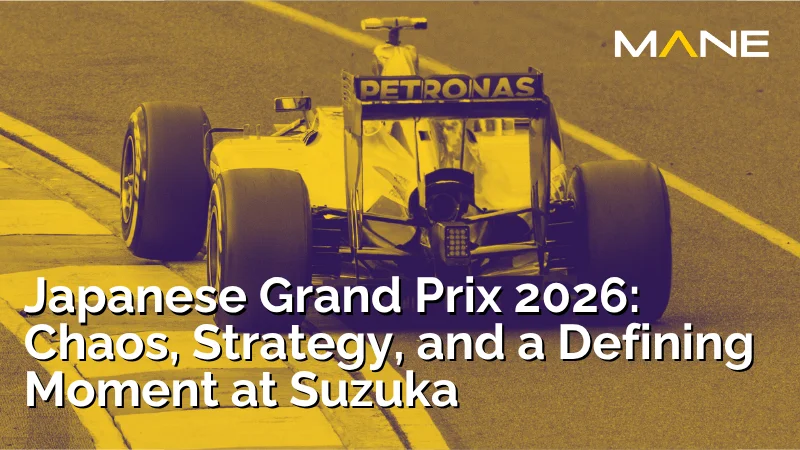
Japanese Grand Prix 2026: Chaos, Strategy, and a Defining Moment at Suzuka
30 Mar, 20264 MINWhen Suzuka Stopped Being PredictableSuzuka has a way of sorting things out. The circuit'...

When Suzuka Stopped Being Predictable
Suzuka has a way of sorting things out. The circuit's combination of high-speed corners, elevation changes, and unforgiving barriers tends to expose weaknesses that smoother tracks allow teams to paper over. When the 2026 Japanese Grand Prix got underway, the expectation was that the fastest car would find clear air, manage its tyres, and control the race from the front. That is not what happened.
What unfolded across the afternoon was a Suzuka 2026 F1 race shaped far more by incident and strategic response than by raw performance. Pace mattered, but it was not the deciding factor.
Two threads ran through the entire afternoon and gave this Japanese GP race breakdown its defining character. The first was Ollie Bearman's high-speed crash, a moment that triggered a safety car and fundamentally rewrote the strategic picture for every team on the grid. The second was Oscar Piastri's race, a performance he would later describe as one of the best of his career, despite it not ending with the result his driving deserved.
Between those two threads, the race refused to follow the expected script.
The Crash That Changed Everything
Ollie Bearman's high-speed crash at Suzuka was the moment the race stopped being a contest of pure pace and became something far more complicated. The incident brought out the safety car at a point when several teams were already committed to strategic positions they had spent considerable effort building. That timing made its consequences particularly severe.
The safety car did what it always does: it arrived at the worst possible moment for some and the best possible moment for others. It compressed the field instantly, wiping out gaps that had taken laps of careful management to establish. Drivers who had pitted early found themselves vulnerable. Those who had held off suddenly had options they had not expected.
Every team on the pit wall was forced into a reactive calculation, weighing tyre life, track position, and the unpredictable window of a restart against whatever plan they had arrived at Suzuka with. In a race where margins were already tight, that recalculation changed everything.
Beyond the immediate strategic fallout, Bearman's crash drew attention to a broader conversation that had been building in the paddock. The incident prompted discussions about safety concerns connected to the 2026 technical regulations, though the precise nature of those concerns remains a matter of ongoing scrutiny rather than settled conclusion. What is clear is that the crash gave those conversations a sharper edge. When a high-speed incident at a circuit as demanding as Suzuka coincides with a new regulatory era, questions about whether the cars are behaving as intended tend to surface quickly, and they did here.
Piastri, the Safety Car, and the Race That Got Away
Before Bearman's crash altered the afternoon, Piastri had been doing what the best drivers do quietly and methodically: building a race that others would struggle to dismantle. He had constructed a lead through a combination of clean driving and smart positioning, the kind of performance that rarely makes headlines in the moment but becomes the story once something goes wrong.
Then the safety car came out.
In F1 strategy analysis 2026, this is the scenario that keeps strategists awake. A driver who has done everything right, managing tyres, managing gaps, managing the race, suddenly finds the field compressed and the work of thirty-plus laps effectively neutralised in a matter of corners. That is precisely what happened to Piastri at Suzuka.
The intervention triggered by Bearman's crash handed every team on the grid a reset. The strategic decisions made in those few compressed minutes ultimately determined the result. Not pace. Not racecraft. Timing and circumstance.
What makes Piastri's reaction worth examining is that he did not come away bitter. He described the Japanese Grand Prix as one of the best races of his career, despite not winning. That is a striking thing to say. It reflects the quality of the performance he felt he had delivered, the assessment of a driver who believes he was close to flawless and knows it, even if the result does not reflect it.
There is a maturity in that framing. He is not deflecting or making excuses. He is separating his own standard from the outcome, which is a distinction that genuinely good drivers learn to make. The safety car did not expose a weakness in Piastri's race. It simply erased the advantage he had earned.
What the 2026 Regulations Are Starting to Reveal
Bearman's crash did more than disrupt a race afternoon. According to reporting by The Independent, the incident prompted wider discussions about safety concerns connected to the 2026 technical regulations. The precise nature of those concerns has not been fully detailed in public reporting, so it would be wrong to overstate what is known. What is fair to say is that the conversation was opened, and Suzuka provided the context in which it happened.
That context matters. The circuit's layout, with its sustained high-speed sections and minimal margin for error, places unique demands on any car. When a new technical formula arrives, it is rarely the controlled conditions of a test session that expose its limits. It is a race like this one, at a track like Suzuka, where the stresses are real and the consequences of getting things wrong are immediate.
This is not a new pattern in Formula 1. Regulatory transitions have historically surfaced challenges that simulations and pre-season running simply cannot replicate. The variables multiply once you add race pace, wheel-to-wheel proximity, and the kind of commitment drivers show through corners that offer no forgiveness.
Whether the concerns raised in the wake of Bearman's crash prove to be isolated or indicative of something that needs addressing, the fact that they are being discussed at all is worth taking seriously. None of this should be read as cause for alarm. Formula 1's regulatory and safety bodies are well-equipped to respond, and the sport has a strong track record of iterating quickly when issues emerge.
A Race Worth Remembering, Whatever Comes Next
Some races stay with you not because of the result, but because of everything that happened around it. Suzuka 2026 was one of those. The interplay of raw pace, tactical decision-making under pressure, and the kind of incident that nobody can plan for produced something genuinely compelling, the sort of afternoon that demonstrates why this sport continues to command attention at every level.
What made the Japanese Grand Prix key moments so striking was how they layered on top of each other. Bearman's crash did not simply neutralise the race. It exposed how quickly a strategic advantage can dissolve, and how much of modern Formula 1 is decided in the moments after something goes wrong rather than the laps before.
Piastri had built something real out there. The fact that he described it as one of the best races of his career, despite not winning, says a great deal about the quality of what unfolded. Winning is the measure, but it is not always the whole story.
Looking ahead, the 2026 season still has plenty to resolve. The regulatory picture is evolving, the conversations around safety are ongoing, and the competitive order is far from settled. If Suzuka is any indication, the races to come will not lack for complexity or consequence.
If you found this analysis useful and would like to explore the automotive and motorsport landscape further, the team at Mane would be glad to hear from you. Whether you are looking for insight into the sector, want to discuss the industry more broadly, or are curious about what Mane's automotive and motorsport expertise could offer, please do get in touch.