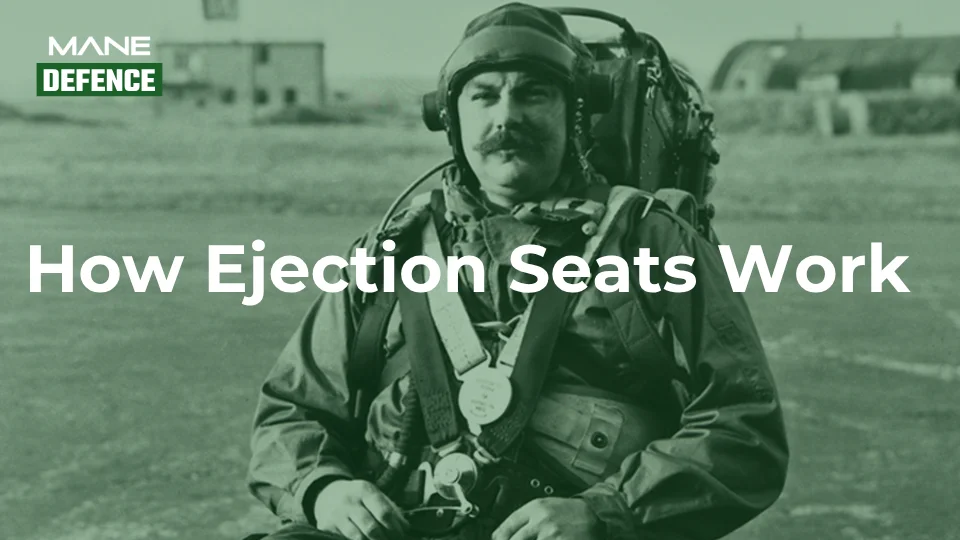
How Ejection Seats Work
21 Apr, 20264 MINThe Engineering Behind Aviation's Most Critical Life-Saving SystemIn the fraction of a s...
The Engineering Behind Aviation's Most Critical Life-Saving System
In the fraction of a second between a pilot pulling the ejection handle and the seat clearing the aircraft, a precisely choreographed sequence of explosive events must unfold without a single failure. The pilot will experience forces equivalent to many times their body weight, the aircraft canopy must be removed without injuring them, a rocket motor must fire to carry them clear, a drogue parachute must stabilise their descent, and an electronic sequencer must calculate the exact moment at which the main parachute should open to give them the best chance of a safe landing. If any element of this sequence fails, the consequences can be fatal. If it works, and in around 90% of cases it does, a pilot who might otherwise have died walks away. Understanding how ejection seats work is not merely a technical exercise: it is a study in the engineering of human survival under extreme conditions.
The Moment of Ejection: Initiating the Sequence
Modern ejection seats, including the Martin-Baker seats fitted to RAF Typhoons and F-35Bs, are initiated by the pilot pulling one of two firing handles, typically located between the legs on the seat pan or above the head on some older designs. Pulling the handle fires an ejection initiator, which triggers a ballistic pressure sequence. In aircraft with a conventional canopy, this pressure first fires the canopy jettison system, blowing the canopy clear of the aircraft to create the exit path. In some designs, particularly where jettison may be too slow or uncertain, the seat is fitted with a canopy piercer at its top, allowing it to punch through the perspex in an emergency. Once the canopy is clear or broken, the main catapult fires.
The catapult is a telescopic gun, typically comprising two or three concentric tubes with an explosive cartridge that drives them apart under high pressure. The explosive charge accelerates the seat and its occupant along guide rails at the rear of the cockpit, clearing the top of the aircraft within fractions of a second. The initial catapult phase keeps acceleration within limits that the human spine can tolerate, typically below ten times the force of gravity, by using a two-stage charge that fires in sequence rather than delivering all the energy simultaneously. This was one of James Martin's key insights during the development of the first seats in the 1940s: a single large charge crushed spines, but a two-stage charge could achieve the necessary velocity at a tolerable rate of acceleration.
The Rocket Motor and Stabilisation
Once the seat has cleared the aircraft's cockpit rails, the Under Seat Rocket Motor, or USRM, ignites. This rocket provides additional upward thrust beyond what the explosive catapult alone can deliver, and it is the USRM that enables zero-zero ejection capability: the ability to eject safely even when the aircraft is on the ground and stationary. Without the rocket, a catapult alone would not generate enough height for the parachute to deploy safely in a ground-level emergency. The rocket burns for a fraction of a second, carrying the seat and pilot to a height from which the recovery sequence can proceed.
As the seat rises, it is also subject to powerful aerodynamic forces that can cause it to tumble or spin, particularly at high airspeeds. Uncontrolled tumbling is dangerous both in itself and because it complicates parachute deployment. Modern seats address this through a combination of stabilisation booms, vernier rockets, and drogue parachutes. The drogue is a small parachute, typically less than two feet in diameter, that deploys from a gun mounted on the seat shortly after the catapult fires. Its purpose is not to slow the seat significantly but to induce drag that keeps it in a stable, upright orientation during the critical seconds before the main parachute deploys.
The Electronic Sequencer and Ejection Modes
One of the most important advances in modern ejection seat design is the electronic sequencer, a computer embedded in the seat that measures airspeed and altitude in real time and uses this data to determine the correct ejection mode. Martin-Baker's current seats operate in three principal modes, determined by the combination of speed and altitude at the moment of ejection. At low altitude and low speed, below approximately 250 knots and 15,000 feet, the main parachute deploys almost immediately, without the drogue, because the priority is getting the pilot to the ground safely before running out of altitude. At low altitude and high speed, above 250 knots, the drogue deploys first to stabilise the seat and shed speed before the main parachute opens, reducing the risk of injury from a high-speed parachute opening shock. At high altitude, the sequencer waits until the seat has descended to a lower altitude before opening the main parachute, preventing the pilot from being exposed to dangerously cold temperatures and low oxygen levels at altitude for longer than necessary.
The sequencer also takes into account the weight of the pilot, using sensors in the seat to adjust the ejection trajectory and timing to optimise survival probability for occupants of different sizes. This matters because the forces involved in ejection scale with the rate of acceleration, and a lighter pilot accelerated by the same explosive charge as a heavier one will experience proportionally higher forces. Martin-Baker's US16E seat for the F-35 incorporates three inflatable airbags activated on ejection to provide head and neck support, a critical addition that helps manage the forces acting on the cervical spine during the initial catapult phase.
Parachute Deployment and Seat Separation
At the point determined by the sequencer, the drogue releases and the main parachute deploys from a container behind the occupant's head. The container is jettisoned and the parachute pays out, creating the drag needed to slow the pilot's descent to a survivable landing speed. As the parachute deploys, the seat separates from the pilot: a mechanical system releases the harness and pushes the seat away, ensuring the pilot descends under the parachute alone without the weight of the seat adding to landing impact. The pilot is now in free descent, typically reaching the ground within two to four seconds of parachute deployment at low altitude or after a longer descent from greater heights.
The survival pack contained within or attached to the seat also deploys during this phase, providing the pilot with emergency equipment including a life raft, signalling devices, water, and medical supplies appropriate to the operating environment. In maritime environments, the pack is designed to float and the life raft inflates automatically. The entire sequence, from handle pull to established parachute descent, takes between two and four seconds depending on conditions. In those seconds, the seat has fired, the rocket has burned, the drogue has stabilised, the sequencer has calculated, and the parachute has opened. When it works, it is an extraordinary piece of engineering. When it fails, the consequences are fatal.
The Limits and Risks of Ejection
Ejection is always a last resort, and the forces involved carry genuine risks of injury even in successful ejections. Spinal compression injuries are the most common consequence of ejection, caused by the high acceleration of the catapult phase. Flail injuries, where limbs are flung outward by the aerodynamic blast as the pilot exits the aircraft, are a risk particularly at high speeds. The operational envelope of modern seats extends from zero altitude and zero speed up to approximately 600 knots and 50,000 feet, but ejections at the extremes of that envelope carry significantly higher injury risk than those within the normal parameters.
Weight is also a factor. The systems in modern seats are calibrated for a range of pilot weights, but lighter pilots, including many female aircrew who weigh significantly less than the male average against which seats have traditionally been designed, can experience higher forces relative to their body mass and are at greater risk of injury. Martin-Baker and other manufacturers have invested in research to understand and mitigate this disparity, and modern seats like the US16E for the F-35 incorporate variable-thrust systems that adjust the ejection trajectory based on sensed pilot weight.
The Impact on Hiring
The engineering that goes into modern ejection seats is as sophisticated as almost anything in the aerospace sector, combining pyrotechnics, structural engineering, biomechanics, avionics, and software in a system whose performance criteria are defined in terms of human survival. The workforce required to design, manufacture, test, and maintain these systems is small, highly specialised, and concentrated in a handful of companies of which Martin-Baker is the global leader. Roles in this sector demand not only technical depth but an exacting attitude to quality and safety that reflects the consequences of failure.
For recruitment professionals working across the defence and aerospace sectors, ejection seat and survival systems engineering represents a niche within a niche. The pool of experienced candidates is genuinely small, and the combination of security clearance requirements, pyrotechnics certifications, and specialised engineering knowledge means that identifying and placing the right individual requires deep sector knowledge. The long service lives of aircraft fitted with Martin-Baker seats, including the F-35's projected operation until the 2060s, mean that the maintenance and periodic refurbishment of the installed seat population creates ongoing demand for qualified technicians across the global fleet.
The GCAP programme's eventual requirement for a new ejection seat will represent a significant commercial and engineering opportunity, with competition expected between Martin-Baker and other manufacturers. The UK's strong position in this domain, built on eight decades of continuous development, gives British industry a competitive advantage that the Ministry of Defence has a strategic interest in preserving. For candidates seeking careers in defence engineering, the ejection seat industry combines profound purpose with genuine technical challenge in a way that very few employment environments can match.