How Britain's Carrier-Borne Fighter Has Become Central to Alliance Defence
11 May, 20264 MINIn November 2025, HMS Prince of Wales steamed through the Mediterranean Sea with 24 F-35B Li...

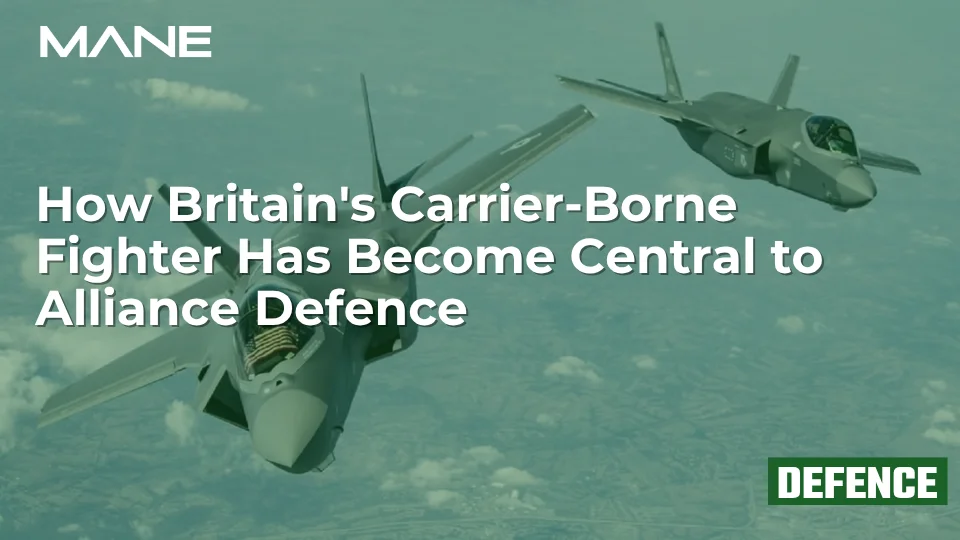
In November 2025, HMS Prince of Wales steamed through the Mediterranean Sea with 24 F-35B Lightning II fighters on its flight deck, the largest number of fifth-generation jets ever assembled aboard a Royal Navy aircraft carrier. The occasion marked the formal declaration of Full Operating Capability for the UK Carrier Strike Group, a milestone that NATO's Defence Secretary described as a landmark moment for European security. It was the culmination of more than two decades of investment, programme delays, industrial challenges, and strategic debate about whether Britain would ever restore the carrier strike capability it had sacrificed with the retirement of the Harrier in 2010. The answer, as Exercise Falcon Strike demonstrated, is that it has. And the F-35B is at the heart of what that capability means for NATO.
What Makes the F-35B Different
The F-35 family comprises three variants sharing a common airframe and many systems but differing significantly in their basing and performance characteristics. The F-35A is a conventional take-off and landing aircraft, the most widely procured of the three variants and the one operated by the US Air Force, as well as by most European F-35 customers. The F-35C is a carrier-optimised variant with folding wingtips, a strengthened undercarriage, and a tailhook, designed for catapult-assisted launch and arrested recovery from US Navy supercarriers. The F-35B is the short take-off and vertical landing variant, derived from the legacy of the AV-8 Harrier, which can use a ski-jump ramp for take-off and land vertically without requiring either catapults or arrestor gear.
The F-35B's vertical landing capability makes it uniquely suited to the Queen Elizabeth class carriers, which were designed around the ski-jump concept to avoid the cost and complexity of fitting catapults and arrestor wires. The trade-off is performance: the F-35B carries less internal fuel than the F-35A, has a shorter combat radius of around 450 nautical miles on internal fuel, and its main internal weapons bay can carry one fewer air-to-air missile than the A variant. The lift fan system that enables vertical landing adds weight and mechanical complexity. These are real limitations, but the F-35B's stealth characteristics, sensor fusion, and network connectivity broadly match those of its siblings, and its ability to operate from a carrier that does not require catapult infrastructure gives it a strategic flexibility that other aircraft cannot replicate.
The UK Carrier Strike Group and NATO
The UK Carrier Strike Group, with HMS Prince of Wales as its current flagship, achieved Full Operating Capability in November 2025 following Exercise Falcon Strike and the wider Operation Highmast deployment. The eight-month deployment covered more than 26,000 nautical miles and engaged with 40 nations, including a transit of the Red Sea and operations in the Indo-Pacific alongside Australian, Japanese, and US partners. At the peak of Exercise Falcon Strike, 24 F-35Bs from 617 Squadron (the Dambusters) and 809 Naval Air Squadron (the Immortals) operated from the carrier alongside Italian and US aircraft in exercises covering deep strike, air interdiction, and suppression of enemy air defences.
NATO's formal declaration of the CSG as combat-ready and its assignment under NATO command represents a significant commitment. HMS Prince of Wales is now positioned as a frontline asset in the Alliance's high-readiness force pool, available to lead strike missions, crisis response operations, and joint air-maritime campaigns. In practical terms, this means that NATO planners can call on a European-based carrier strike capability that does not depend on US Navy assets, giving the Alliance additional strategic depth at a time when the security environment in the Baltic, Black Sea, and Eastern Mediterranean is more demanding than at any point since the Cold War.
Interoperability and the Alliance Dimension
One of the most powerful demonstrations during Exercise Falcon Strike was the cross-decking of Italian F-35Bs with their British counterparts on HMS Prince of Wales. Allied aircraft operating from a British carrier, with shared mission planning and synchronised strike packages, is precisely the kind of interoperability that NATO's credibility in deterrence depends upon. The shared platform means that UK and Italian F-35B pilots can operate from each other's ships with minimal adaptation, creating genuine flexibility in how allied carrier air power is deployed and sustained.
The F-35's sensor fusion and data-sharing architecture also makes it a central node in the networked battlespace. The aircraft's Distributed Aperture System and Active Electronically Scanned Array radar feed information not only to the pilot but to other aircraft, ships, and ground stations in the battlespace, functioning as a kind of flying intelligence platform as much as a strike aircraft. This capability is particularly valuable when operating alongside legacy fourth-generation aircraft such as the Typhoon, which lacks the same stealth and sensor integration but benefits enormously from the situational awareness the F-35 provides through datalink.
Current Limitations and Future Development
Full Operating Capability, whilst a significant milestone, does not mean the UK's carrier strike capability is fully mature. The National Audit Office's 2025 report noted several persistent gaps. Sovereign stealth coating maintenance facilities at RAF Marham remain unfinished, meaning the UK still depends on US facilities for some aspects of maintaining the aircraft's stealth characteristics. Aircraft availability across the fleet has sat below 60%, driven partly by engineer shortages that the MoD acknowledges will take at least four years to fully address. The integration of the Meteor beyond-visual-range air-to-air missile and the SPEAR-3 stand-off weapon with the F-35B is tied to the delayed Block 4 software upgrade and is unlikely to be complete before around 2030.
These gaps matter. Operating the F-35B without Meteor until around 2030 means the carrier's air wing is less capable in the beyond-visual-range air-to-air combat mission than it should be. However, the trajectory is clear: with the Carrier Strike Group now formally NATO-committed, the engineering and software upgrades progressing, and the pipeline of 15 additional F-35Bs from the next tranche under contract, the UK's carrier strike capability is on an improving curve rather than a declining one.
The Impact on Hiring
The achievement of Full Operating Capability for the UK Carrier Strike Group, combined with the formal NATO commitment of HMS Prince of Wales, creates a sustained and growing demand for the specialist workforce that supports F-35B operations. The MoD has publicly acknowledged the retention and recruitment crisis in F-35 engineering, and has put in place joining bonuses for engineers and expanded capacity in Technical Training Schools to increase the throughput of qualified maintainers. These measures reflect the reality that the skills required to maintain a fifth-generation combat aircraft are genuinely scarce and in competition with both the commercial aerospace sector and other defence programmes.
For recruitment agencies placing professionals in the defence and aerospace sectors, the F-35B programme represents one of the most sustained long-term hiring requirements in the UK's order of battle. Airframe technicians, avionics engineers, software support specialists, and test and evaluation professionals are all in demand, and the long service life anticipated for the aircraft, with current planning assuming operation until 2069, means that this demand will persist across multiple career generations. The naval aviation dimension adds further complexity, with the Royal Navy and RAF operating the aircraft jointly through the Lightning Force at RAF Marham, creating a workforce that spans both single-service cultures.
Beyond the maintenance workforce, the carrier's operations generate demand for a wide range of supporting professionals. Intelligence analysts, mission planners, logistics specialists, and cyber security experts all play roles in sustaining carrier strike operations. The deployments undertaken by the CSG on Operation Highmast demonstrated the scale and complexity of the enterprise, involving not only the carrier and its air wing but a task group of frigates, destroyers, submarines, and auxiliaries, each with their own specialist workforce requirements. Defence recruitment specialists who understand this ecosystem are increasingly valued by the organisations building and sustaining these teams.