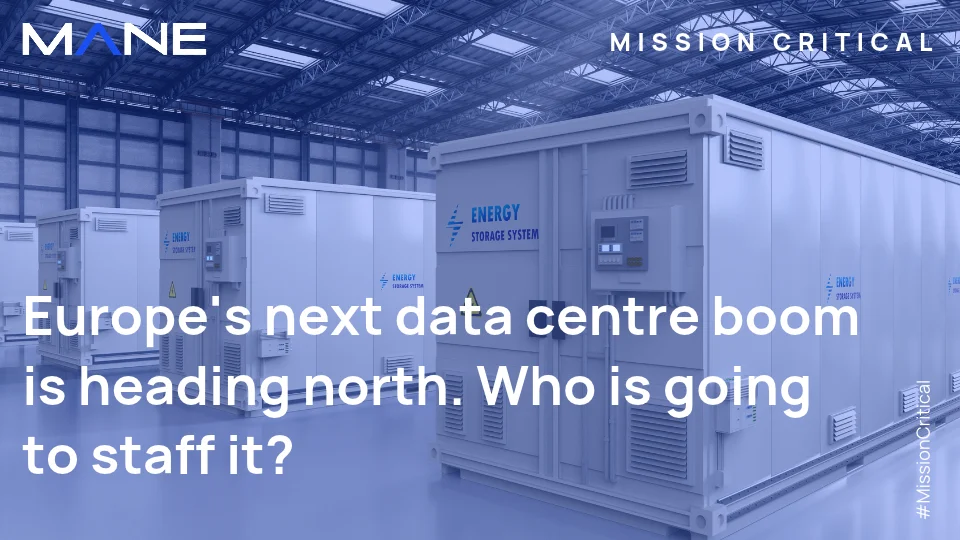
Europe's next data centre boom is heading north. Who is going to staff it?
24 Nov, 20264 MinIn January, one market research tracker put Finland's upcoming data centre pipeline at more ...

In January, one market research tracker put Finland's upcoming data centre pipeline at more than 3GW. By May, the same tracker put it at more than 6GW. Not every one of those megawatts will get built. But when a pipeline doubles in a few months, it tells you where developers think the power is.
Why the north
If Europe's problem is power, the Nordics are the most obvious answer. They have large volumes of hydro and wind, a cold climate that cuts cooling costs for much of the year, and in many areas a grid queue measured in months rather than years. Compare that with the eight-year waits now being quoted in parts of the UK, and the appeal is clear.
The market itself is still relatively small. There are roughly 137 colocation data centres across Denmark, Finland, Iceland, Norway and Sweden, with Sweden accounting for around 45% of Nordic construction capacity in 2025. What has changed is the pipeline, the size of the individual projects and the type of customer now looking north.
Two projects that tell the story
Narvik, Norway. Announced in 2025 as Stargate Norway, this is a 230MW campus inside the Arctic Circle, designed around renewable power and closed-loop direct-to-chip liquid cooling. In April, OpenAI and the developer Nscale failed to agree terms. Microsoft stepped in, adding 30,000 Nvidia Vera Rubin GPUs on top of an existing $6.2bn commitment at the site. The anchor tenant changed, and the project kept going. That's what happens when you have power in a place where the rest of the market is short of it.
Espoo, Finland. Microsoft and Fortum are building a data centre region designed from the start to feed the local district heating network. Once running, its waste heat is expected to cover about 40% of the heating needs of around 250,000 users in Espoo and neighbouring towns, replacing coal. The city expects the project to create about 2,000 construction jobs and 200 to 300 permanent roles.
Espoo matters beyond Finland. With the EU about to grade data centres publicly on energy and water, heat reuse stops being a nice story and becomes a competitive advantage. The Nordics already have the district heating networks to make it work at scale, which most of Europe does not.
What this means for hiring
The maths doesn't work locally. One Finnish campus is expected to need around 2,000 construction workers. The region has gigawatts in the pipeline and small populations to draw on. A large share of the specialist workforce will have to come from elsewhere in Europe, and the projects that plan for that early will move fastest.
Remote sites need a different offer. Narvik is a long way from anywhere. Rotation patterns, travel, housing and family support will decide who signs, more than base salary. Clients who treat the package as an afterthought will struggle to fill senior roles.
Heat reuse is a new specialism. Engineers who understand heat pumps, district heating integration and the commercial agreements with energy companies are rare. Nordic sites will need them first, and the rest of Europe will be competing for them soon after.
Liquid cooling and HV, again. AI-density halls need the same core skills here as anywhere else: liquid cooling design and commissioning, HV electrical and controls. The difference is that the Nordic talent pool for these skills is small, so competition for experienced people is intense.
Local knowledge still matters. Permitting, municipal relationships, labour agreements and the way teams are run all differ from the UK or Germany. The strongest project teams mix experienced international delivery people with Nordic hires who know how things get done locally.
A natural next step
Many of the engineers and delivery leads Nordic projects need are already working across Europe. They've built in constrained markets like Frankfurt, London and Dublin, and they know how to deliver under pressure. The opportunity now is to connect that experience with projects that finally have the power to move quickly.
If you're building in the Nordics, or you're a European engineer curious about what's happening there, we'd like to talk.