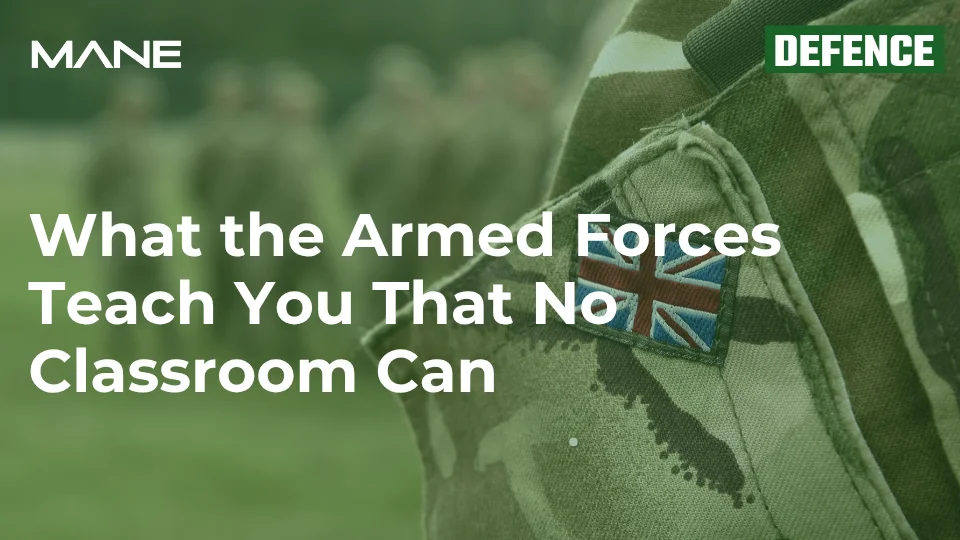
What the Armed Forces Teach You That No Classroom Can
26 Jun, 20263 MinEvery year on Armed Forces Day, the country pauses to acknowledge the men and women who serv...

Every year on Armed Forces Day, the country pauses to acknowledge the men and women who serve, have served, and support those who do. It is a moment of recognition that is well deserved. But beyond the ceremonies and the flag raisings, there is a conversation that does not always get the attention it warrants: what happens when that service ends, and what those individuals carry with them into the rest of their working lives.
At Mane Defence, we work with this community every day. We have seen, again and again, what people who have served in the armed forces bring to the organisations they join. Not as a policy point or a diversity initiative. Just as a simple truth about the kind of people they are and what their experience has forged in them.
Discipline that runs deeper than the surface
People often talk about military discipline as if it is purely about following orders or keeping kit clean. It goes much further than that. People who have served understand what it means to hold yourself to a standard when nobody is watching, when conditions are difficult, when the easy option is right there in front of you. That internal compass does not disappear when the uniform comes off. It shows up in how they approach a deadline, how they manage a project when things go sideways, how they treat colleagues under pressure.
Decision making when the stakes are real
Military environments ask people to make clear-headed decisions under conditions that most workplace scenarios will never come close to. That experience builds a particular kind of judgement: the ability to assess what you know, acknowledge what you do not, and act anyway. In fast-moving business environments, that quality is rare and it is valuable. The people who have exercised it in genuine high-stakes situations tend to carry it naturally into whatever they do next.
Leadership that is about the team, not the title
The armed forces develop leaders at every level. A corporal with three years of service has already had to motivate, manage, and take responsibility for the people around them in ways that many corporate managers spend entire careers trying to learn. Leadership in the military is not about status. It is about getting the job done and bringing your team with you. That grounding shapes how veterans think about management, about accountability, and about the relationship between rank and respect.
The ability to function under pressure
Stress is a universal feature of working life. But there is a difference between the everyday pressure of targets and deadlines, and the kind of sustained high-pressure environments that military service can involve. Those who have operated in the latter develop a resilience and a steadiness that becomes a genuine asset in any team. Not because they are unaffected by difficulty, but because they have learned how to keep functioning through it.
Adaptability built through real experience
Military careers are rarely linear or predictable. People who have served have typically had to adapt to new environments, new roles, new teams, and new challenges repeatedly throughout their career. That adaptability is not a soft skill picked up in a workshop. It is something built through lived experience in conditions that demanded it. In organisations that are trying to navigate change, that quality matters enormously.
The value of genuine teamwork
There is something about having genuinely depended on the people around you that changes how you approach collaboration. In civilian workplaces, teamwork is often a concept. For those who have served, it is something they have lived. They know what it means to rely on colleagues, to be reliable for them in return, and to understand that the success of the team matters more than individual credit. That orientation does not switch off.
Loyalty and commitment mean something
Commitment is easy to claim on a CV. It is harder to demonstrate over years of service, often in demanding conditions, often away from family, often without any of the creature comforts of ordinary working life. The people who have done that bring a proven version of commitment to whatever they do next. They have already shown what they are made of.
Armed Forces Day is a time to say thank you. And it should be. But if we are being honest, a thank you on its own does not go very far. It feels good in the moment and then the weekend ends and everything goes back to how it was.
The thing we would really like to see change is how veterans are received when they walk into a job interview. Because there is still a version of this that happens too often: someone with ten or fifteen years of serious, demanding, genuinely impressive service sits across from a hiring manager who looks at their CV and does not quite know what to do with it. They see job titles that do not map neatly onto corporate org charts. They see deployments and operational tours and wonder, sometimes out loud, whether this person will fit into their culture.
It is a strange thing to worry about. The person sitting across from them has probably integrated into more teams, adapted to more environments, and had to get up to speed in more unfamiliar situations than anyone else in the building. They have done it under conditions that most of us will never face. And the concern is whether they will fit in.
What tends to happen, when organisations actually take the time to understand what a military background involves, is that the worry evaporates pretty quickly. A corporal who has led people through a six-month deployment has done more genuine people management than many mid-level managers who have been in post for years. Someone from the signals or intelligence world has handled complexity, ambiguity, and high-stakes communication in ways that translate directly into almost any technical or analytical role. The skills are absolutely there. They just need someone willing to read them properly.
And beyond the specific skills, there is something harder to define but just as real. People who have served tend to bring a seriousness of purpose to their work. Not in a humourless way. In the sense that they understand what it means to actually be responsible for something, to not let people down, to keep going when it would be easier not to. That does not come from a training course. It comes from having genuinely lived it.
The organisations that get this, that actively look for veterans rather than treating them as an afterthought, tend to notice the difference fairly quickly. Not because veterans are somehow superhuman, but because the values and habits that military service builds are exactly the ones that most workplaces spend years trying to develop in people through away days and leadership programmes and management frameworks.
Armed Forces Day comes round once a year. The parades are worth attending, the events are worth supporting, and the moment of collective recognition genuinely matters. But the most meaningful thing any employer can do this weekend is less visible than all of that. It is deciding to look at the next veteran CV that lands on their desk with a bit more curiosity and a bit less hesitation. That is where gratitude becomes something more useful.